Quality as the Foundation of Our Products
High quality, reliable products and continuous improvement of our processes are key elements of our corporate philosophy.
ISO 9001
We are only content when you are.
We use the ISO 9001:2015 quality management system for continuous process optimisation and to ensure our high product and service quality in the long term.

Energy and Operational Measures
Since 2006, we have been operating two combined heat and power plants that produce electricity and whose waste heat we utilise for our heating and water system, among other things. In addition, we have been generating ‘summer solar power’ via our photovoltaic systems on our company roofs since 2008.
In 2019, we doubled the collector output from 30 kWp to 60 kWp and integrated an E3DC storage system with an output of 40 kW, meaning that we currently produce more electricity than we consume. We also have several wallbox charging stations for company and employee electric vehicles.
WEEE
Waste Electrical and Electronic Equipment - EU directive to reduce the increasing amount of electronic waste from electrical and electronic equipment that is no longer in use. The aim is to avoid, reduce and dispose of the increasing quantities of electronic waste in an environmentally friendly manner by extending producer responsibility for the products.
SOMMER CABLE complies with the applicable WEEE requirements for the relevant products.
RoHS
The RoHS Directive (Restriction of certain Hazardous Substances) of the European Union (EU) regulates the restriction of the use of hazardous substances to a maximum of 0.1%. The EU Directive 2002/95/EC (RoHS 1) has prohibited the use of cadmium (Cd), mercury (Hg), hexavalent chromium (Cr (VI)), polybrominated biphenyls (PBBs) and polybrominated diphenyl ethers (PBDEs) as well as lead (Pb) in electrical and electronic devices since July 2006.
Since July 2019, Directive 2015/863/EU (RoHS 3) applies, which has included the following additional substances: Bis(2-ethylhexyl) phthalate (DEHP), benzyl butyl phthalate (BBP), dibutyl phthalate (DBP) and diisobutyl phthalate (DIBP). The RoHS information for our products can be found in a separate column on our price list.
Print Media and Packaging
As a company, we continuously consider environmental aspects when making our decisions. As a manufacturer of high-quality cables and connection components, this presents a particular challenge. Even with efficient production processes, manufacturing and operation inevitably require energy and resources. We therefore focus on areas where we can actively influence the use of materials and resources. In addition to generating our own electricity through photovoltaic systems, we also pay attention to the responsible use of materials and resources when selecting print media and packaging materials.
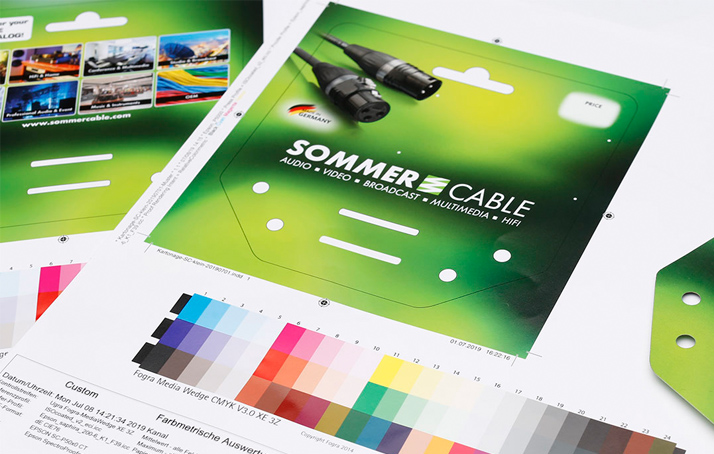
For our printed materials, we work with certified production partners who, among other things, use paper from certified or responsibly managed forestry sources. When selecting print and packaging materials, we pay attention to suitable materials and an appropriate design. We continuously review opportunities for further optimisation.
Our Exhibition Stand Offers More Than Just One Appearance
We also focus on reuse when designing our exhibition presence: our fully modular exhibition stand system, developed over many years, integrates the transport cases directly into the stand. The individual modules can be reused at different events and flexibly combined with one another. This not only saves time during setup and dismantling, but also enables repeated use of our exhibition stand.

Cables and Wires – Materials, Technical Properties and Recycling
Cables are made from different materials, which have different properties and recovery options depending on the product and its design. Conductors, for example, can be made of copper or aluminium. Other components may include PVC, PUR, TPE or silicone.
During the processing of waste and surplus cables, the various components are separated. Materials such as copper and certain plastics can be recovered and used as secondary raw materials for industrial applications. Whether and to what extent individual components can be recovered depends on the material composition, product design and available recycling processes.
Material Selection and Technical Properties
We develop our cables and connection components with the requirements of their respective applications in mind. Material selection, design and manufacturing processes are tailored to the intended electrical and mechanical loads.
Depending on the application, factors such as flexibility, temperature resistance, mechanical strength, low-temperature flexibility and material resistance play an important role. These properties are specified in the respective product data.
Connectors also contain materials such as steel, copper, aluminium and nickel. Whether and to what extent these materials can be recovered after use likewise depends on their design, material composition and the available recycling processes.
We aim to provide transparency about the materials used in our products and their technical properties. Rather than making general statements about the environmental impact of a product, we focus on specific material and product characteristics. The materials used in a specific product are listed in the respective technical product information.
Our Commitment
Our commitment remains unchanged: reliable products, precision manufacturing and high quality – made in Germany.